
It's a warm and humid summer evening, the Missouri cicadas whine endlessly, a crescent moon hangs over AFB Whiteman's concrete plain. A sickle-thin moon floods above, fading against the sodium vapor haze that shimmered above the flight-line.
Exactly at 23:51 local, the first of six B-2A Spirits, tail 89-0129, Spirit of Georgia, emerges from Dock 8. Heat mirages ripple around the aircraft's black skin as she eases onto the taxiway, absorbing every lamp that tries to find an edge. In the cockpit Major Lara "Banshee" Ruiz keyed the last item on her digital card: GPS-Aided INS: triple check, green. Two bays aft, twin GBU-57C MOPs reported good fuse alignment. Twelve tons of tungsten steel showed as steady green icons on the weapons page.
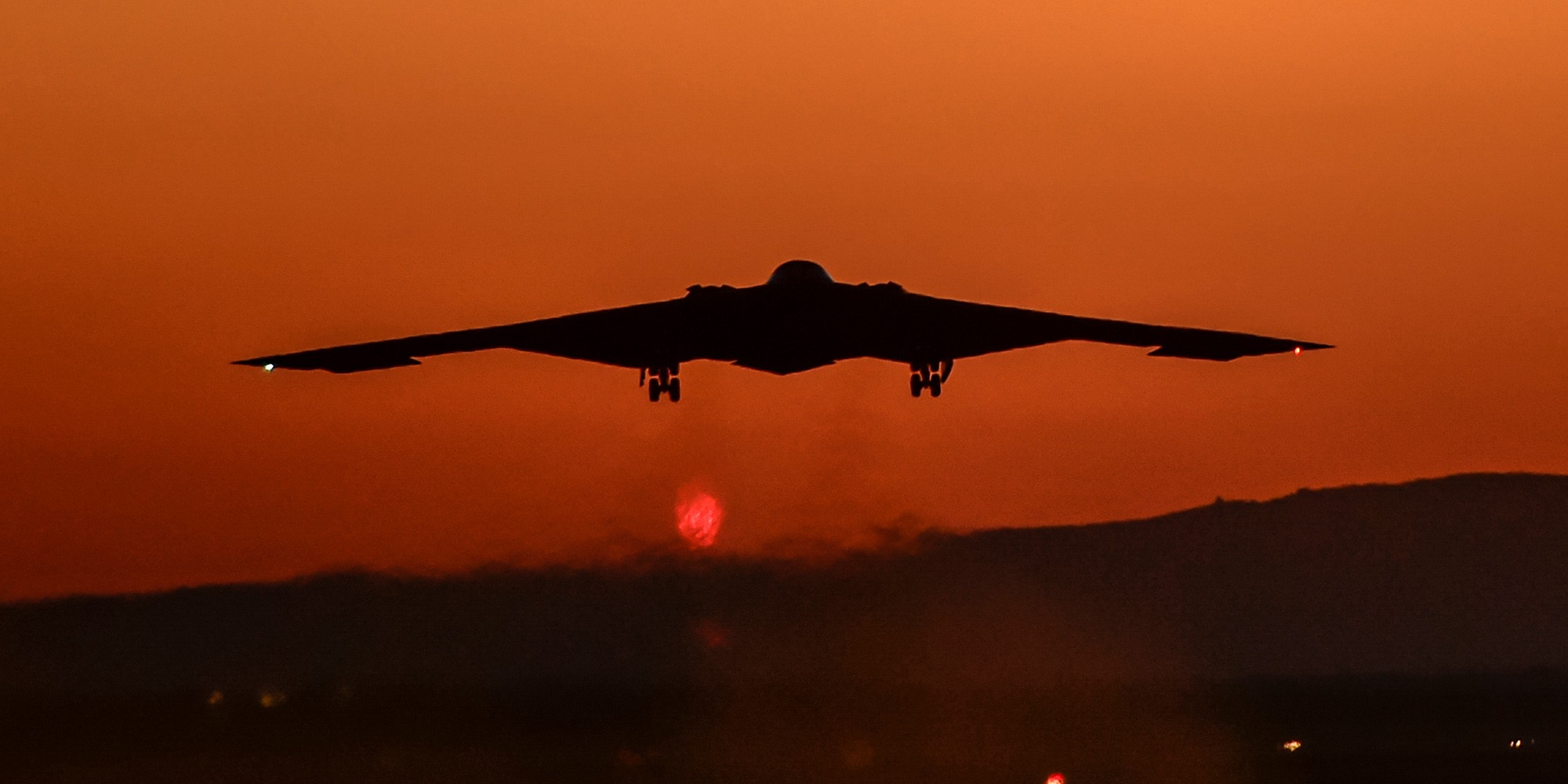
"Spirit One, runway two-one, winds calm, cleared for departure. Safe flight," the tower intoned. Ruiz released the brakes, the bomber's twin F118-GE-100s spooled to life with a growl, pushing the bomber down the centerline. At forty knots the landing lights snapped off; blackout protocols turned Georgia into a moving void against the humid darkness. Ninety knots, then one-thirty, rotation. Vapor whips from her serrated leading edges as she climbed through the haze, engines throttled to combat power, coarse needle settling on a track that would curve across the Atlantic, slip beneath Europe's radar fences, and dive toward the Zagros before dawn reached Iran.
Fordow is a deeply buried uranium-enrichment plant carved into the iranian limestone hills 30 km south-east of Qom at 34.8845° N, 50.9981° E. An old Revolutionary Guard garrison hollowed out so that the working halls sit roughly 80-90 m (260-295 ft) beneath the surface, far below the reach of most conventional bunker-busters.
Concealment is part of the architecture. Five adits pierce the mountainside, feeding galleries that add up to about 54 000 ft² of shielded floor-space, just enough for sixteen full centrifuge cascades and the piping galleries that serve them. Almost nothing is visible from above except the portal blast doors, a ventilation stack and a scattered security cantonment. Everything that matters happens behind a hillside of Jurassic-Cretaceous carbonate rock measuring up to thirteen kilotonnes per square metre of bearing strength.
Iran began tunnelling in secret between 2002 and 2004 but admitted the site's existence only in September 2009 after Western intelligence blew its cover; President Obama famously called the size and configuration "inconsistent with a peaceful programme." The IAEA placed Fordow under safeguards, yet its mission soon shifted. By late 2011 Iran had transferred the production of 20 % low-enriched uranium from Natanz to Fordow, arguing that the mountain was insurance against air-strikes (it is).
Today the plant is the heart of Iran's sprint capability. According to the Agency's 31 May 2025 report, inspectors verified two interconnected IR-6 cascades already producing 60 % U-235, the threshold feedstock for a weapons dash, while Iran has authorization to swap the remaining six IR-1 cascades in Unit 2 for IR-6 machines as well. In all, about 2 700 centrifuges, roughly half advanced models, are installed, giving Fordow enough throughput to turn its 60 % stockpile into nine atom bombs' worth of weapons-grade material in a matter of weeks and can do so essential without the threat of any conventional attack.
Under the 2015 JCPOA Fordow was supposed to stop enriching altogether and host a stable-isotope research centre. That arrangement collapsed after the U.S. withdrawal in 2018. Since then Iran has not only resumed enrichment but in February 2023 briefly pushed product to 83.7 %, less than 7% away from weapons grade uranium, an excursion the IAEA called "seriously concerning."
Physical protection matches the plant's strategic value. In August 2016 Tehran emplaced an S-300PMU-2 battery on the ridgeline above the portals and routinely supplements it with Tor-M1 SPAAGs inside the perimeter. Satellite images place the main launch revetments at roughly 34.889 N 50.991 E. Together with the mountain overburden, those missiles mean only U.S. B-2-delivered GBU-57 Massive Ordnance Penetrators, or a protracted sabotage campaign, offer a realistic path to physically collapsing the cascade halls.
When Lisa Ruiz and her B-2A Spirit bomber arrived over Fordow, the following must have already occurred. Firstly, there can be no threat from Iranian air defense. The US and its coalition must have air-superiority. Secondly, Iranian C2 must be both blind, deaf or both. Iranian command should not be able to communicate or assess attacks at Fordow before the strikes occur, Israeli strikes have already degraded basically all of Iran's SAM and C3 assets in Western Iran which is a good step for the US. Here's how I'd like each stage to work in real life.
Eight to five hours prior to the bomb dropping, US naval assets in the Gulf or within the range of the BGM-109 TLAM Blk V's 1666+ km range (exact range is classified) open up with salvo after salvo. In my scenario two Ohio-class SSGNs and two Arleigh Burke destroyers salvo more or less 200~ Tomahawks (many with LMAC (Large Multi-Effects Warhead System)) that can penetrate hardened structures and bunkers. This wave in coordination with aerial SEAD assets will destroy every S-300/400/Barvar-373, Big Bird, and Khordad-15 battery within 400km of Qom. These cruise missiles could come from any ships in the 5th fleet still within range, or any new assets that are there right now (that is classified).
Five hours to three hours before the strike. Four ships of F-22As from Al Dhafra and another Four ships of F-15EXs from Prince Sultan next to Riyadh punch through any possible remaining Iranian air assets. ROE is weapons free on radar hot to prevent any cues on the six B-2s. E/A-18Gs from a nearby CSG and with tanker support fly over the Gulf of Oman and blanket the 2-8 Ghz slice with wide-band Barracuda jamming; EA-37Bs at 46,000 feet in the same place spoof Link 11 and Iran's C2 microwave rings. This should render every S-300 battery and runway either destroyed or electronically blind. No radar should be able to track a Spirit before it can drop.
Now onto the second requirement. This is happening ten to six hours before the strike. A mobile Counter-Communications System (CCS) "Meadowlands" van, flown in under canvas on one of the many cargo flights to Al Dhafra AFB, locks its dish on the X-band down-link used by Iran's Noor-2 and Noor-3 CubeSats. The new Meadowlands payload can send its software based transmitter across wide slices of spectrum and when the satellites pop thousands of kilometers away, over the Arabian horizon, the van pours tailored noise into the channel, denying telemetry and imagery to the lone IRGC ground station at Semnan which has already been targeted by coalition airstrikes and will soon be again. The U.S. Space Force green-lit Meadowlands for field use literally last month on 2 May 2025, specifically to let joint forces "detect, identify and disrupt adversary sat-com systems" at forward sites, exactly what the crew now does in real time.
Eight to six hours before the strike. Within Iran, the national IADS rides on a fibre ring run by Khatam-al-Anbiya. Dormant U.S. Cyber Command tools—procured under the Combat Mission Force budget for "full-spectrum offensive cyberspace operations" now awaken. They inject spoofed BGP adverts that re-route key /24 blocks through empty null paths. Routers at Birjand, Dezful and Tehran start "route-flap storms," basically routers changing internet paths too fast for networks and physical hardware to accommodate which forces operators to isolate sectors. With the backbone choking, Fordow's ridge-top S-300 battery loses its datalink to long-range search radars just as the Space-Force jammers are taking away the orbital picture. And in a couple hours now undetectable surface skimming tomahawks will blow these up.
From six hours to four hours before the strike. Coalition aircraft with AGM-88G AARGM-ER anti-rad missiles to home in on the Jamkaran reserve S-200s 5N62 'Square Pair' radar bunkers and the microwave repeater on top of Kahak Ridge. Fordow's local fibre is now physically cut.
Now only four to two hours before the strike. To confuse any SPAAGs or remaining radar systems that went unnoticed and to confuse operations in Iran, a four ship of F-16Cs from Prince Sultan AFB release swarms of ADM-160 MALD-J and MALD-X decoys to swamp search radars and return phantom signals with stand-in jamming bursts. The flying E/A-18Gs cue on the decoys footprint and layer this in wideband barrages over Iranian C2 frequencies, and behind them a E-11A BACN relay stitches US Link 16 networks together without ever illuminating Iranian receivers.
Now two hours before Lisa arrives. Iran's Noor satellites are blind or jammed, IADs are gone, local sensors are either destroyed or beyond confusion.
It is now time for Lisa and the five other B-2A pilots to strike. The planes cross the Zagros ridge west of Qom at 40,000 ft, throttled back to M 0.75 in min-observable cruise. They fly in trails with ten miles separation to keep exhaust plumes from overlapping on any IR sensors. Fordow underneath the mountain based on Israeli-seized design drawings (Project Al-Ghadir) show two parallel cascade halls, each 250 meters long and 13 meters wide, separated by a central service gallery. The roof of the halls lies 80-90 meters beneath Jurassic-Cretaceous limestone, a depth which has been backed by the IAEA and independent geology surveys.
The bombing plan will go as follows. Two Massive Ordnance Penetrators to each of four precise aim-points inside the enrichment complex and another pair to the surface tunnels, with two weapons held in reserve for contingencies. In Hall 1 the primary impact point lies at UTM 39R 436 460 E 3 861 700 N, where Raven 11 and Raven 12 will drop in rapid succession to punch a vertical shaft through the roof and blast a crater down to the cascade floor. Roughly sixty metres west, at 436 520 E 3 861 680 N, Raven 13 and Raven 14 will strike the offset aim-point whose role is to cave in the western third of the hall and destabilise the adjacent sidewall. Hall 2 mirrors this pattern: its centre is targeted at 436 600 E 3 861 730 N by Raven 21 and Raven 22, while the offset position at 436 660 E 3 861 710 N will receive Raven 23 and Raven 24. The twin entrance adits and utility gallery on the north face of the mountain, located at 436 390 E 3 861 790 N, will be sealed by Raven 31 followed moments later by Raven 32, ensuring all power and ventilation lines are severed. Raven 33 and Raven 34 remain onboard as airborne spares, ready to be retasked instantly should any primary weapon fail to release or deviate from its programmed flight path.
Each GBU-57A/B Massive Ordnance Penetrator (MOP) delivers about 1.1 × 10⁹ joules of impact energy (13 600 kg at ~400 m s⁻¹). Tests quoted by both the USAF and Boeing show that a single round will push ≈ 60 m (200 ft) through 5 000 psi reinforced concrete or ≈ 8 m (25 ft) through 10 000 psi ultra-high-strength concrete. Translate that to rock: competent Jurassic-Cretaceous limestone like the ridge over Fordow typically runs 2 – 4 ksi (14 – 28 MPa). Under that resistance the same energy-balance calculation gives a theoretical reach of ≈ 90 m, comfortably matching Fordow's 80–90 m overburden. One bomb, properly aligned, can therefore punch all the way to a cascade hall. A two-bomb "stack drill" guarantees it.
The first MOP slams on target at 21:50 local. For one-third of the penetrator is simply a streak of tungsten drilling almost vertically into the ground, then slowly decelerates into a crawl, the new void sensing fuse fires and 2.4 tons of AFX-757 explosive detonates. Seven seconds later the sister round follows the same feature down the same shaft and detonates three meters deeper, levering a slap of roof the size of an aircraft carrier into total free fall. Before that slab is even to land, four more strikes are underway.
After the strike, within thirty or so seconds a Persian Gulf seismology station 780 km away will record a magnitude 2.3 or so earthquake at an almost 0 km depth. Iranian operators will now know it was too late as their GEO link has been jammed since four hours before. Just seconds later the final MOP will explode at the portal hinge line. In the following half an hour IRGC forces will roll from Qom to inspect the damage, and likely be blocked by mounds of debris. Within an hour a US KH-11 optical satellite will pass over and capture the mountain crest under the first light of day. They will relay the success of the strike and repeat again if necessary.
Fordow will not survive.