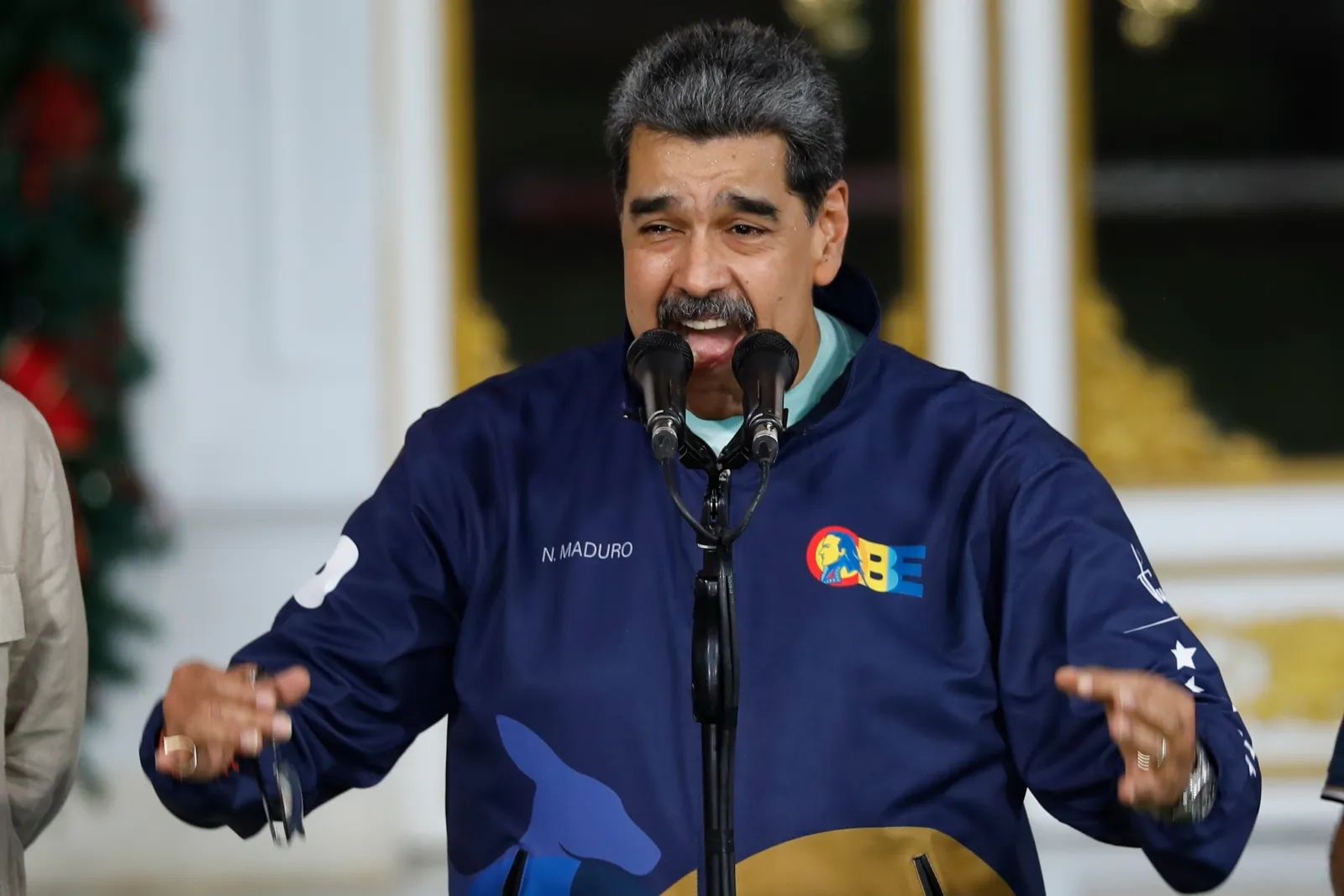
When Chávez's presidency began in 1998, he immediately began to reform Venezuela. Chávez followed a similar approach to Mexico and other oil-producing nations in the Western Hemisphere by nationalizing Venezuela's immense oil reserves to provide support for the impoverished in his country, ultimately lowering the poverty rate by 15%. However, under Chávez, corruption emerged along with a stark dependence on oil exports. After Chavez's death in 2013, his vice-president, Nicolás Maduro, assumed office and began his term by continuing the same themes of economic mismanagement and internal corruption. Maduro's popularity quickly began to fade, and in 2015, the opposition was elected into the national assembly, ostensibly limiting his power. The tipping point arrived in 2018, when Venezuela's government declared Nicolás Maduro the winner of a deeply contested election that was almost certainly not fair or accurate. Maduro's tenuous victory led to a global proxy conflict in which most of the West placed sanctions on Maduro's regime. As sanctions on Venezuelan oil grew, Maduro's government turned to other revenue streams to support its regime.
As the country became increasingly desperate under expanding international sanctions, mining and smuggling out gold emerged as a lucrative source of revenue. Gold is mined illegally along riverbeds by private militaries, warlords, and cartels who supervise the operations and are often paid partly in the gold they harvest. To keep costs low, heavy machinery tears apart the jungle floor to reach deposits, while mercury and other harmful chemicals are used in crude techniques to concentrate the gold, making it easier to extract. It is documented that Indigenous groups are forced to work as slaves in these dangerous conditions to further reduce labor costs. Once collected, the product is sent to refineries, both legal and illegal, before being moved into the broader smuggling network. Usually, the gold is unmarked and not reported to international trade authorities to evade oversight and sanctions enforcement. A unique feature of gold is that it legally enters the global market at a relatively consistent level, largely due to the high costs associated with mining and refining it safely and correctly. This consistency creates a distinct space for undocumented gold, which can trade as if it were mined through standard legal channels while avoiding regulatory costs and oversight, allowing it to circulate without immediately damaging the overall market. While Venezuela's unreported exports are illegal, this lack of oversight keeps them cheap. Gold is so sought after that many countries, including Brazil, do not even require proof of how or where it was obtained.
On official records, as of 2022, Venezuela exported 153 million U.S. dollars' worth of gold, with over 96% of that going to Lebanon. However, according to a 2023 report from the Organized Crime and Corruption Reporting Project, approximately 4.8 billion dollars' worth of gold is extracted annually from Venezuela, far surpassing the country's reported export figures and highlighting the vast scale of the illegal gold exports. One key enabler of illegal gold exports is gold's unique ability to be easily smuggled. Unlike other contraband, gold can be melted into different forms, hidden within legal or illegal exports, and transported across borders while revealing little about its origin. Usually, this contraband is smuggled across borders to neighboring Colombia, Brazil, and Guyana, where it is smuggled internationally. Another major avenue for moving Venezuelan gold is through existing cartel routes. Cartels such as Tren de Aragua and the Cartel de los Soles use their preexisting ground and sea corridors to transport gold, incorporating it into their usual cargo. When the time comes to move the gold into its final destination, it is far easier and cheaper to smuggle than the drugs it traveled with, so it is typically offloaded and sold separately. In some cases, gold even functions as a form of currency, used for bribes or exchanged to secure safer passage for other illicit goods.
The revenue from the illicit gold trade helps support the Venezuelan government as it attempts to weather economic sanctions and obtain supplies it can't legally purchase. Venezuela's proxies also use the gold they harvest to supply Maduro's regime with armaments, sometimes directly purchased with gold. The cartels often maintain stockpiles of armaments that Maduro can purchase, supplementing the support he receives from abroad. He also trades with Russia and Iran, countries that have little incentive to avoid antagonizing the United States or the West. These nations, in turn, can use Venezuelan gold to finance their own illicit activities, relying on its untraceable nature to evade international monitoring.
To maintain plausible deniability, Maduro often pays his proxies by allowing them to harvest the gold themselves. In doing so, he still acquires the weapons and supplies he desperately needs while avoiding direct implication in the contraband. To maintain his purported innocence, Maduro has actively criticized the cartels for illegally mining gold in the region, but has taken no action against them. This fits into the broader theme of Maduro's relationship with illegal groups amid the rising US-Venezuela conflict. The United States and the Trump Administration have dramatically increased their military presence and their aggression in the area in the past few months and even days, making the risk of a conflict high. Since September 2, 2025, the United States has struck a suspected cartel boat leaving Venezuelan territory nearly every week, claiming that it is striking cartel activity with a direct connection to Maduro's regime. Maduro has continuously claimed that he is not connected to the drug trade, yet still condemns the US for their unprompted attacks.
Regardless of how the conflict unfolds, it is clear that Venezuela will likely continue producing gold, likely at an increased rate, to fund the conflict. Even if Maduro's regime falls quickly, the cheap production of gold, just like drug production, will prove to be the backbone of any regime in Maduro's place. The trends will likely continue, as escalation increases, so too will the flow of gold, so the more that Venezuela gets sanctioned and backed into a corner, the more desperate Maduro will be for money to retaliate, resulting in even more smuggling of gold and drugs. Therefore, the global supply of gold will remain high as long as Maduro's regime maintains control over Venezuela. More specifically, as long as the proxies are allowed to mine gold cheaply and with buyers, gold will continue to flow out of Venezuela and into the global market.
This proposes an interesting yet precarious situation for the United States as it continues to escalate the conflict. The interests of Maduro's regime have previously and historically conflicted with the interests of Washington and its allies in the region. The primary interest of Washington is to attack the cartels and weaken Maduro in the process. Yet, the proxy warlords and private militaries in the region could continue fighting and bring chaos to the region. Maduro could circumvent this by using his resources as a bargaining chip, offering the United States a valuable trading relationship of gold, oil, and other resources in exchange for peace. Similar to the Trump Administration's proposed aid package in Ukraine, Washington could shoot for peace in exchange for resources and a military presence in the region. Because preventing the drug trade and cartels is of utmost importance for Washington, they will likely proceed using that as their motive regardless.
Other markets could see an increase in gold traced back to Venezuelan mining, particularly China and the oil-producing nations of the Middle East. Rather than simply serving as additional destinations for smuggled gold, these states are poised to become more significant future purchasers as geopolitical dynamics shift. The price of gold has appreciated by almost 40% in 2025, and China has begun to increase its reserves, but mostly with gold that goes undocumented. This allows China to take full advantage of gold's economic power by purchasing secretly from Venezuela while avoiding destabilizing the whole market. China has already demonstrated its willingness to support Venezuela through previous rounds of sanctions, so the flow of infrastructure investment, technology, and diplomatic support will likely continue in the same way. Meanwhile, several Middle Eastern governments, prioritizing strategic self-interest over alignment with Western pressure, may seek to use Venezuelan gold as part of broader efforts to diversify their economies away from oil. Oil and gold have a very unique relationship, with oil often being more profitable, yet also riskier in times of global economic turmoil. Gold, on the other hand, has historically been consistently profitable and stable. This makes gold the perfect monetary complement to oil. Venezuela's illicit gold trade is likely to offer a unique opportunity to access a large amount of gold quickly and cheaply, not merely as a byproduct of smuggling networks, but as a deliberate economic and geopolitical move.
Washington is increasingly escalating the conflict with Venezuela every day, yet Maduro's regime is faced with a singular, desperate option to survive the sanctions and fight against the global superpower. The warlords and cartels that are proxies of Venezuela will continue their horrible humanitarian practices to crudely mine gold in the forests of Venezuela and sell the gold to whoever is willing to buy. This situation will briefly increase the global supply of gold while the conflict lasts, but it will not be sustainable, only providing an option as long as corruption and chaos persist. As the United States escalates pressure on cartel networks and systematically disrupts the infrastructure sustaining Venezuela's illicit mining economy, gold production will diminish. Stripped of the cheap labor and substandard extraction practices that once undercut global norms, supply will tighten, lifting prices and nudging the market back toward a more sustainable equilibrium. As the United States moves toward a post-Maduro regime in Venezuela, Washington must recognize both the power and the fragility of this resource in maintaining stability. Although gold has been mined for centuries, it remains an important universal currency, one that has increased nearly 300% in value over the past ten years. Regardless of what the Venezuelan regime looks like in the coming years, gold will undoubtedly remain a central element of the country's political and economic significance.